
Renovated your rental? The ATO’s free formula might be quietly taxing you at the higher rate.
Two separate reforms from the same Budget are now sitting on top of each other for anyone holding established residential property. Most coverage treats them as unrelated stories — one about negative gearing, one about capital gains tax. For a property actually held today, they're not separate at all. They interact, and the interaction matters most if you've renovated.
Here's how the two systems actually stack.
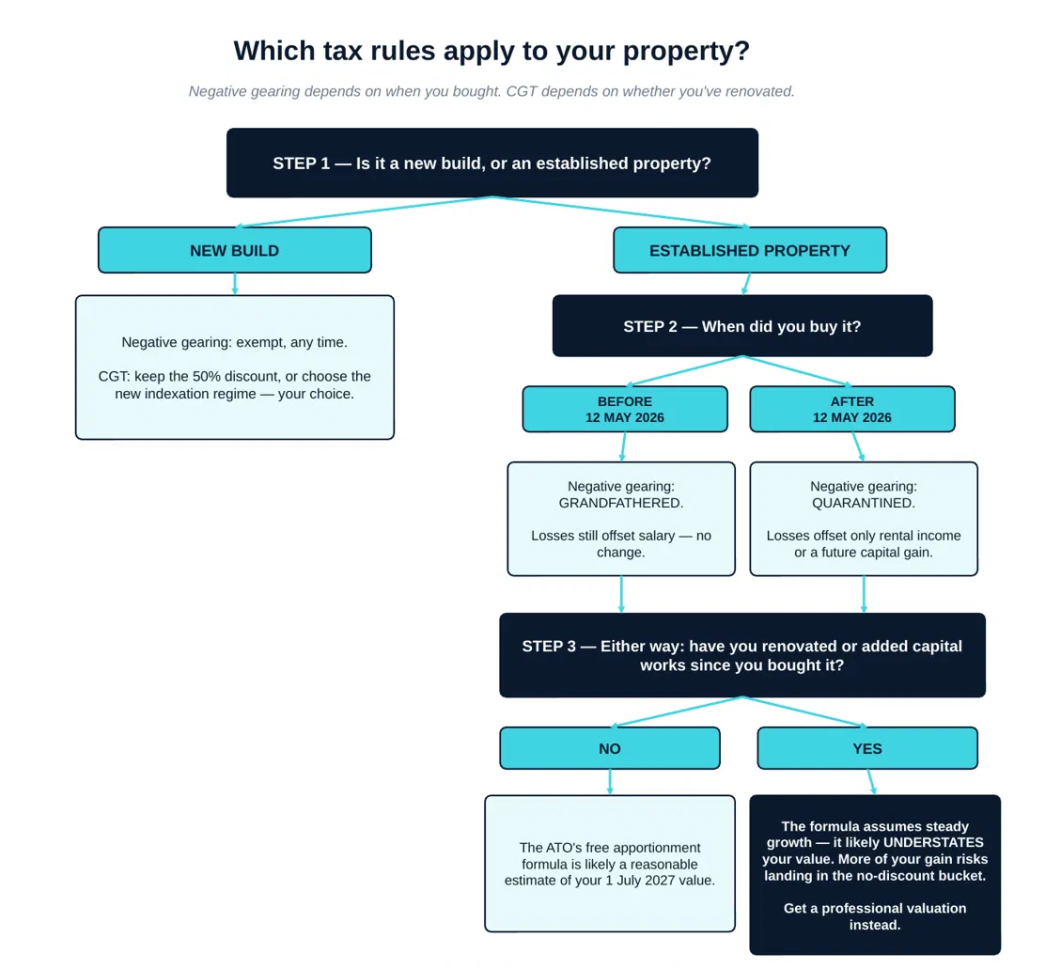
Negative gearing: three categories, one date
From 1 July 2027, a rental loss on an established property is treated differently depending on when it was bought — the dividing line is Budget night, 12 May 2026, 7:30pm.
- Established property, bought before 12 May 2026 — fully grandfathered. Losses still offset salary, no change.
- Established property, bought after 12 May 2026 — quarantined. Losses can only offset rental income or a future capital gain, not salary.
- New build, any time — fully exempt. Unaffected regardless of purchase date.
This part has been reasonably well covered. What's had far less airtime is the second reform sitting on the same properties.
The CGT reset: a second date, a second set of categories
The Treasury Laws Amendment (Tax Reform No. 1) Act 2026 received Royal Assent in June 2026 and takes effect 1 July 2027. From that date, the 50% CGT discount is replaced by cost-base indexation plus a 30% minimum tax on the net gain — for individuals, trusts and partnerships.
Every property held across that date effectively gets treated as sold and reacquired at its market value on 30 June 2027. The gain built up before that date keeps the old 50% discount. The gain built up after that date is taxed under the new indexation-plus-minimum-tax rules, with no discount at all.
Which bucket your gain falls into depends entirely on one number: what the property was worth at 1 July 2027. And that number can be established two ways:
- A professional valuation, or
- The ATO's free apportionment formula, which estimates the 1 July 2027 value by assuming the property grew at one steady rate across the entire time you've owned it.
Where renovations create the trap
The formula's steady-rate assumption is the whole problem for anyone who's renovated. A renovation doesn't add value gradually — it adds a lump of value at one point in time, then the property appreciates normally from there. A formula built on "steady growth the whole way through" has no way to see that step-up.
The practical effect: the formula understates the 1 July 2027 value of a renovated property. A lower deemed value at the transition date means less of the eventual gain falls into the old, discounted bucket, and more of it falls into the new bucket — taxed under indexation and a 30% minimum rate, with no discount available at all.
This isn't a penalty on renovating. It's a penalty on using a one-size-fits-all formula on a property that didn't grow in a straight line. A proper valuation, done at or near 1 July 2027, captures the renovation-driven step-up accurately and locks the correct share of the gain into the still-concessional pre-2027 treatment.
Where new builds sit in both systems
New builds get favourable treatment twice over. They're already exempt from the negative gearing quarantine regardless of purchase date. They also keep a choice under the CGT reform — retaining the legacy 50% discount as an alternative to the new indexation and minimum-tax model. Every other established property, grandfathered or quarantined, faces the same 1 July 2027 valuation question with no equivalent opt-out.
“Grandfathered” only protects you from one of these
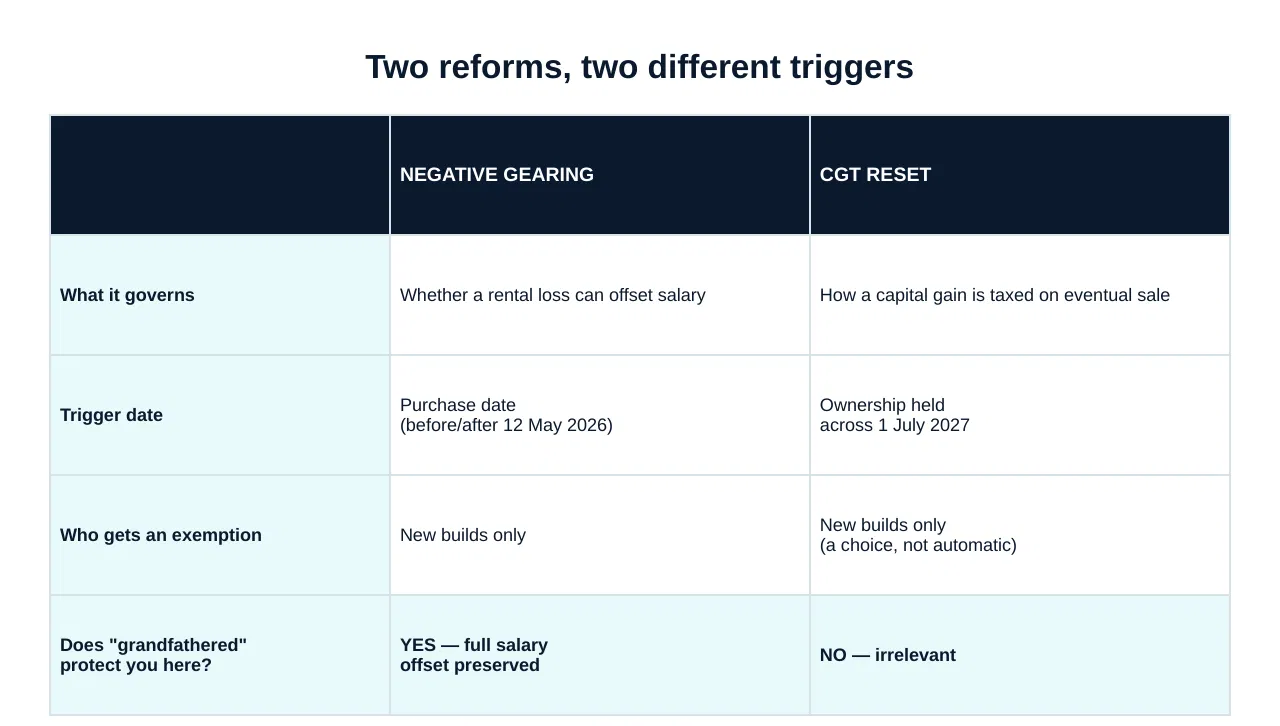
Easy to misread the sections above as meaning a grandfathered property is safe from both reforms. It isn't — the two mechanisms run on completely separate triggers, and grandfathering only touches one of them.
Negative gearing grandfathering is about whether a rental loss can offset salary. It's determined once, by purchase date, and doesn't change.
The CGT reset is about how a capital gain is taxed on eventual sale. It applies based on whether you're still holding the asset on 1 July 2027 — nothing to do with when you bought it, and nothing to do with your negative gearing bucket.
A property bought in 2005 — fully grandfathered, zero change to how its rental losses are treated — still gets exactly the same 1 July 2027 valuation treatment as a property bought last month. The CGT reform doesn't check negative gearing status at all. It even reaches pre-1985 assets, previously exempt from CGT entirely: gains accrued before 1 July 2027 stay exempt, but anything accruing after that date is taxed under the new rules.
The only genuine exemption from the CGT side is new builds, and that's a separate carve-out tied to build status — unrelated to purchase date or negative gearing treatment. Every other property, however it's classified for negative gearing purposes, faces the same 1 July 2027 valuation question.
What this means for a conversation you're probably already having
Every established property — whether it's fully grandfathered for negative gearing purposes or caught by the post-12 May quarantine — needs the same decision made before 1 July 2027: get a real certified valuation, or accept whatever the ATO's formula assumes. For an unrenovated property with genuinely steady growth, the formula might be a reasonable shortcut. For anything that's had capital works, an extension, or a substantial renovation, the formula is very likely selling the owner short.
That's a concrete, checkable question for any investor-vendor conversation between now and mid-2027: has this property been renovated since purchase, and if so, has anyone actually modelled what the ATO's formula versus a real valuation does to the eventual tax bill?
Has this property been renovated since purchase, and by how much?
None of this is advice on any individual's position — the right approach depends on the specific property, when it was renovated, and by how much. If you're trying to work out what it means for a specific property or client conversation, that's worth a proper discussion. Send me a DM.